Why More South Africans Are Moving Back to Gauteng — And What It Means for Property
For years, semigration stories were dominated by one narrative: South Africans leaving Gauteng for the Western Cape in search of a better lifestyle, safer suburbs, mountain views, and coastal living.
But the conversation is changing.
A growing number of South Africans are now making the move back to Gauteng — and the reasons are becoming increasingly practical rather than emotional.
Recent migration and property data suggest that affordability, career opportunities, housing value, and economic sustainability are beginning to outweigh lifestyle aspirations for many working professionals and families.
The Reality Behind Reverse Semigration
The Western Cape still holds strong appeal. Cape Town remains one of the country’s most desirable cities, offering lifestyle, tourism, natural beauty, and strong municipal performance.
However, many households are now discovering that lifestyle comes at a cost.
The combination of:
Higher property prices
Rising rental costs
Increased daily living expenses
Longer commuting distances
Slower salary growth outside specialist sectors
has created pressure on middle-income households trying to maintain financial flexibility.
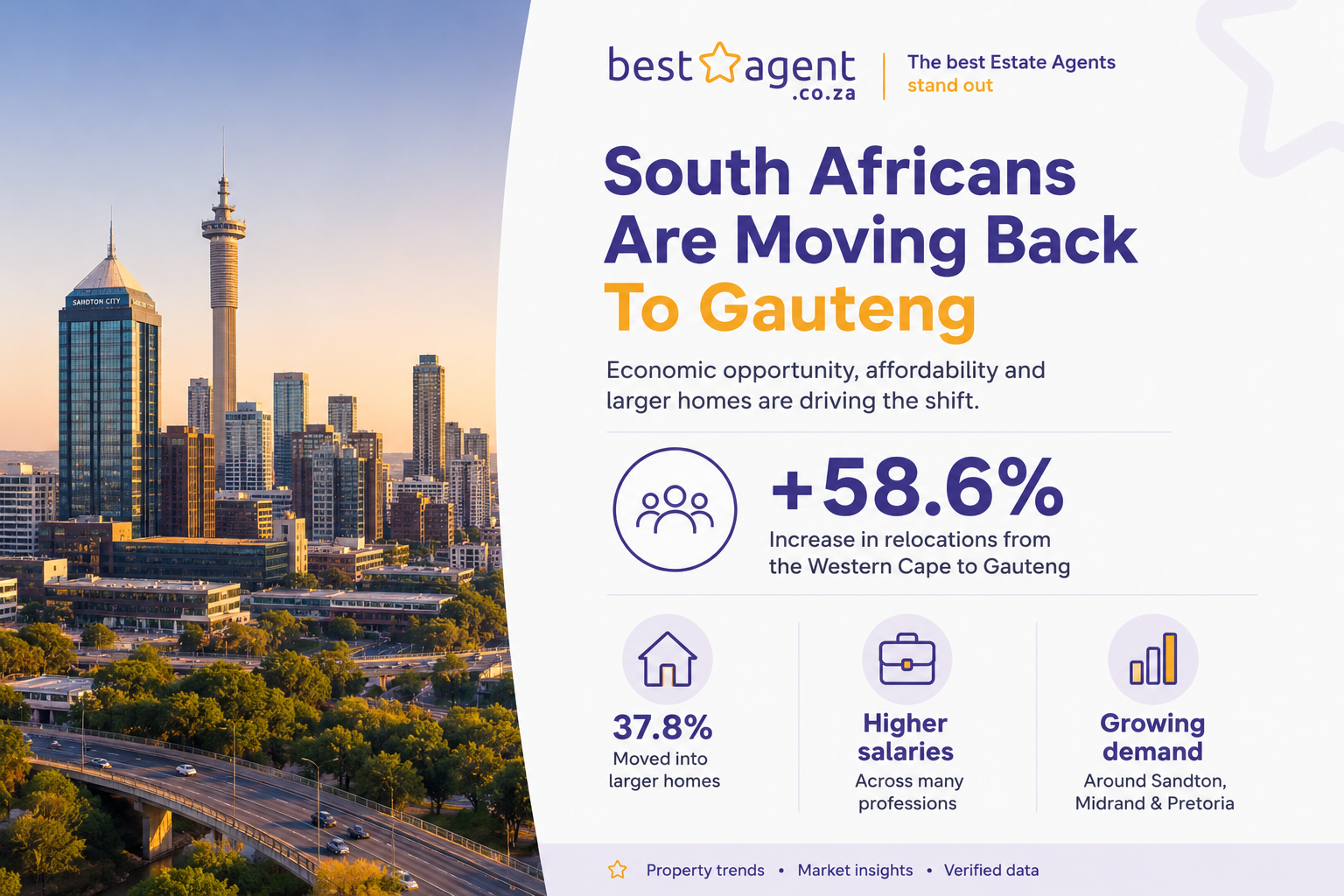
According to recent migration data, relocations from the Western Cape back to Gauteng increased by as much as 58.6% year-on-year in 2025.
And importantly, many of these movers are not downgrading — they are upgrading.
More than a third of households returning to Gauteng reportedly moved into larger homes, while relatively few downsized.
Gauteng Still Drives South Africa’s Economy
While semigration captured headlines over the past few years, Gauteng never stopped being South Africa’s economic engine.
Johannesburg, Sandton, Midrand, Pretoria, and Centurion continue to offer:
The country’s largest concentration of corporate headquarters
Stronger employment opportunities
Higher average salaries
Better career progression in many sectors
Access to major business and financial hubs
Salary data further reinforces this trend.
In many industries, Gauteng salaries remain significantly higher than national averages and often exceed equivalent opportunities elsewhere in the country.
For example:
Receptionists
Gauteng: R10 884 – R14 047
Western Cape: R10 365 – R13 442
Sales Consultants
Gauteng: R20 515 – R28 246
Western Cape: R20 180 – R27 410
Accountants
Gauteng: R33 681 – R47 768
Western Cape: R32 550 – R42 828
In some professions, Gauteng salaries are reportedly up to 19% higher than national averages.
At the same time, Gauteng often still offers better value per square metre when purchasing or renting property.
That combination of higher earning potential and improved housing value is becoming increasingly difficult for many households to ignore.
The Cost of Lifestyle
For many semigrants, the original move was driven by quality-of-life considerations:
Remote work flexibility
Coastal living
Outdoor lifestyle
Perceived better governance
Family-focused living
But as hybrid work models evolve and more companies encourage employees back to offices, proximity to economic centres is once again becoming important.
Many younger professionals are now reassessing:
Career growth potential
Long-term affordability
Schooling costs
Commute efficiency
Investment value
Future earning opportunities
The result is not necessarily the end of semigration — but rather a shift in who can sustainably afford it.
Higher-income earners and remote workers may continue moving coastal, while middle-market professionals increasingly prioritise economic resilience and career accessibility.
What This Means for the Property Market
This shift creates important opportunities for Gauteng’s residential market.
Areas close to business nodes such as:
Sandton
Fourways
Midrand
Centurion
Pretoria East
Bedfordview
Rosebank
could continue seeing renewed demand from:
Returning professionals
Young families
First-time buyers
Rental tenants relocating for work
It also reinforces a broader market reality:
Property decisions are no longer purely lifestyle-driven. Buyers are becoming more analytical and financially strategic.
Affordability, value retention, career access, and long-term sustainability are increasingly shaping buying behaviour.
The Bigger Picture
The Western Cape remains a highly desirable province, and semigration is far from over.
But South Africa’s migration trends are becoming more balanced and economically nuanced.
For many households, the question is no longer:
“Where would I love to live?”
It’s becoming:
“Where can I build a sustainable future?”
And for a growing number of South Africans, Gauteng is once again answering that question convincingly.
Looking to buy, sell, or compare property opportunities in Gauteng or across South Africa?
Visit Best Agent to compare verified estate agents based on real sales performance, local expertise, and market results.